Paper 2 Breakthroughs
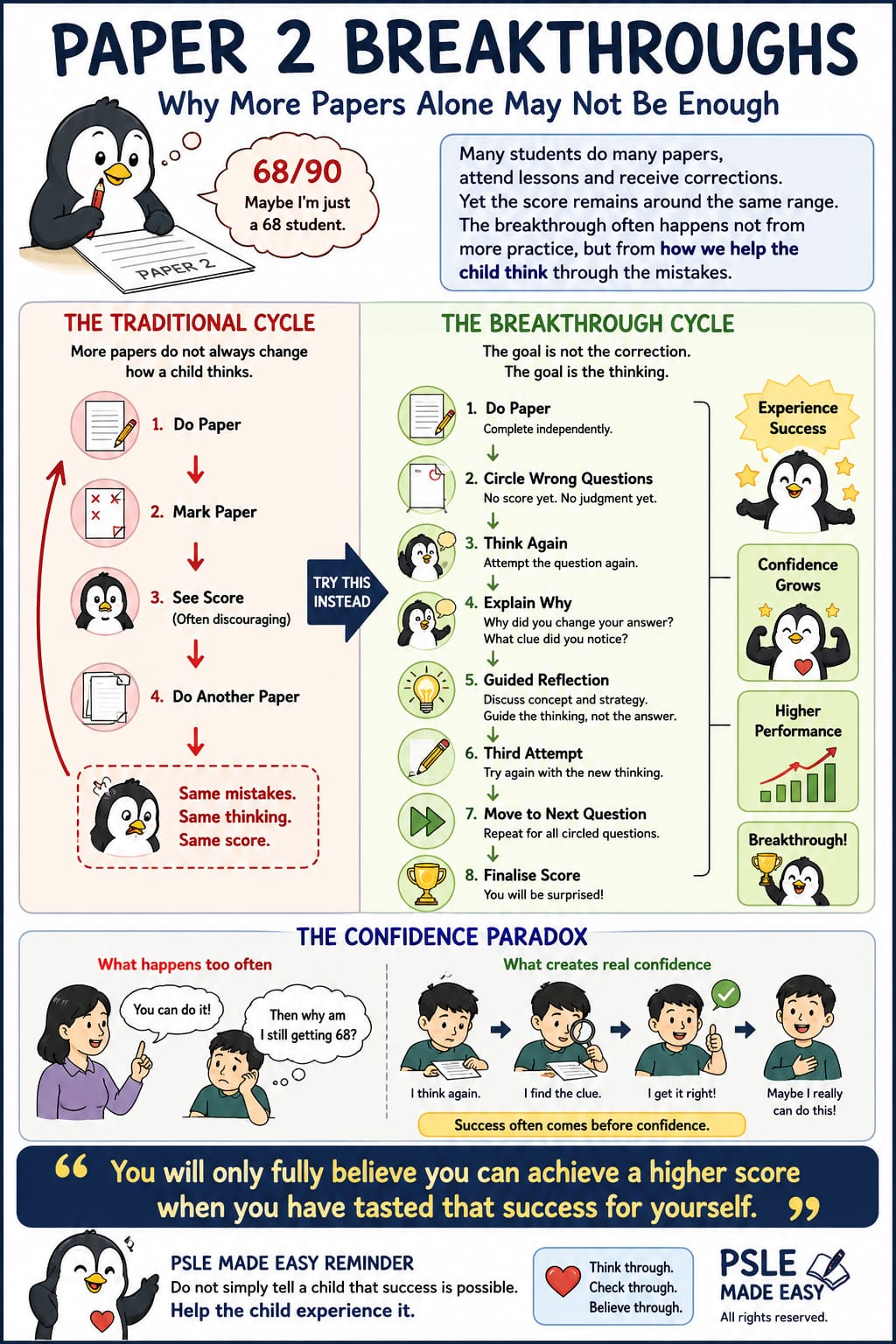 The role of thinking, confidence and guided reflection — and why the breakthrough is often already inside the child.
Some students plateau around 65–75 out of 90 for Paper 2. They have done many practice papers. They attend tuition. They know the strategies. Yet the score does not move.
This is one of the most frustrating situations in P6 English preparation — for students, parents and teachers alike. And the solution is often not what most people expect.
Parent Note
If your child is stuck despite practice and support, this page is worth reading carefully. The method below can be done at home with a completed practice paper. You do not need to be a teacher to use it. You need to be patient, curious and willing to ask questions rather than give answers.
The goal is not to correct your child. The goal is to help your child discover what they already know.
Student Note
“You probably know more than you think. The problem is often retrieval, not knowledge.”
“The breakthrough is not hidden in another worksheet. It is hidden in how you think about your mistakes.”
① Why Students Plateau
When a student has done twenty practice papers and the score is still around 70, more practice papers are unlikely to be the answer.
Most P6 students have already been taught the concepts and strategies required for PSLE English. The issue is usually not a gap in teaching. The issue is often one of these three things:
- Retrieval under pressure. The student knows the strategy but cannot access it independently during the examination.
- Careless errors that repeat. The same types of mistakes keep appearing without the student understanding why.
- Confidence that has not caught up with ability. The student has the skill but does not yet believe the higher score is possible.
All three of these problems have the same root: the child has not experienced enough success to believe success is real.
“A child who repeatedly experiences failure starts believing failure. A child who repeatedly experiences success starts believing success.”
② The Guided Re-Attempt Method
This method can be done at home after your child completes a practice paper. It takes longer than marking and moving on — but it produces a very different result.
Step 1 — Let the child complete the paper independently.
No help during the paper. Let them work through it fully on their own.
Step 2 — Mark it yourself. Circle the wrong answers. Do not reveal the score.
Do not total the marks. Do not tell them what the score is. Simply circle the questions that are wrong and hand the paper back.
Step 3 — Ask the child to attempt each circled question again.
One at a time. After each second attempt, ask these questions — not to check the answer, but to uncover the thinking:
- “What made you change your answer?”
- “What clue did you notice this time?”
- “What are you thinking now that you did not notice before?”
Step 4 — If the child is still wrong, guide the thinking. Do not supply the answer.
Ask guiding questions. Review what the question is actually asking. Discuss the concept. Help the child think — not guess. Then allow a third attempt.
Step 5 — After all circled questions are revisited, finalise the score.
Only now should the full score be calculated — including the questions the child corrected through re-attempt. This score reflects what the child is capable of when they think carefully.
“Help the child think. Do not help the child guess.”
③ Why This Works
When the child corrects a question through their own re-attempt — not because you told them the answer, not because they copied from the answer key — something important happens.
The child begins to realise:
- “I actually knew this.”
- “I found the clue after checking.”
- “I remembered the strategy.”
- “I could explain my thinking.”
These are not small moments. They are the beginning of evidence-based confidence — confidence that grows from personal experience of competence, not from being told “you can do it.”
Adults often assume confidence comes before success. But for many children, it is the other way around. Success comes first. Confidence follows.
A child who repeatedly sees that they can find the answer when they think carefully will start to believe that the higher score is within reach. Not because someone said so — because they experienced it themselves.
“Do not simply tell a child that success is possible. Help the child experience it.”
④ What This Looks Like in Practice
Most parents who try this are surprised by two things.
First, how many questions the child can correct on their own when given the chance to try again. The knowledge was there. It just was not accessed the first time.
Second, how the child’s relationship with mistakes begins to change. Instead of shame or frustration, there is curiosity — “what did I miss?” instead of “I got it wrong again.”
Over several sessions, students typically begin to:
- Check more deliberately during the actual paper.
- Slow down on questions they are unsure of rather than guessing and moving on.
- Explain their reasoning more clearly — which means their thinking is becoming clearer.
- Believe that a higher score is achievable, because they have already seen it.
“The breakthrough is often not hidden inside another worksheet. It is hidden inside the child.”
⑤ If Your Child Needs More Guided Support
The method above works best when someone can sit beside the child, slow the process down and guide the thinking in real time. At home, this takes patience and time — both of which are not always available.
For students who need this kind of guided, personalised support — especially in the months leading up to PSLE — small group and individual sessions are available. These are not mass tuition classes. They are structured around exactly this approach: slowing down, thinking through mistakes, building confidence through competence.
If you are considering support, start with a short conversation. WhatsApp 8335 0709 with a brief description of where your child is and what you are hoping to address.
“A child becomes confident because the child experiences success. Help the child experience it.”