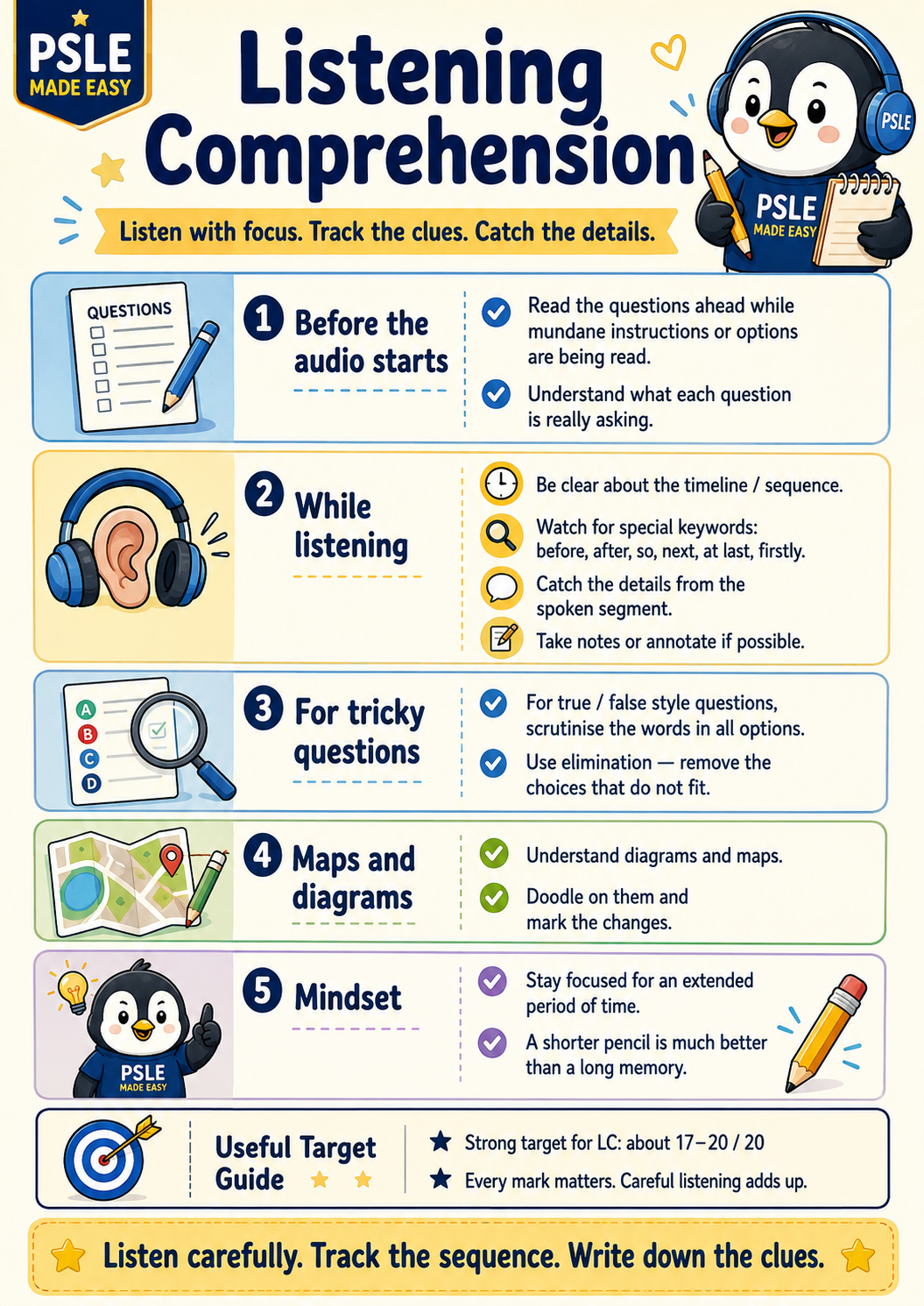
Listen with Focus. Track the Clues. Catch the Details.
A guide to active listening, note-taking and careful answering.
Listening Comprehension rewards students who prepare before the audio, stay active during it and use elimination carefully for tricky questions.
A strong target is 17–20 out of 20. Every mark matters. Careful listening adds up.
Parent Note
Listening Comprehension is the one component students cannot practise by re-reading. It requires sustained focus over an extended period — a skill that improves with deliberate practice, not just exam drilling.
Help your child practise active listening at home by asking them to summarise what they heard from a podcast, news clip or audiobook. Ask: what was the sequence? What changed? What was the key detail? These are exactly the questions LC tests.
Remind your child that a shorter pencil is much better than a long memory — writing down clues during the audio is not optional, it is essential.
Student Note
“Listen carefully. Track the sequence. Write down the clues.”
“A shorter pencil is much better than a long memory.”
“Strong target for LC: 17–20 out of 20. Every mark matters.”
① Before the Audio Starts
Use the time before the audio begins wisely — do not wait passively.
- Read the questions ahead while instructions or options are being read aloud.
- Understand what each question is really asking.
- Mark keywords in each question so you know what to listen for.
“Read the questions before the audio. Know what to listen for before it starts.”
② While Listening
Stay active throughout the entire audio. Do not zone out between questions.
- Be clear about the timeline and sequence of events.
- Watch for special keywords: before, after, so, next, at last, firstly.
- Catch the specific details from each spoken segment.
- Take notes or annotate your question paper as you listen.
“Track the sequence. The keywords tell you when things happen.”
③ For Tricky Questions
Some LC questions are deliberately difficult. Use these strategies:
- For true / false style questions — scrutinise every word in each option. One wrong detail makes the whole option false.
- Use elimination — remove the choices that definitely do not fit.
- If unsure, make your best choice and move on. Do not leave blanks.
“Scrutinise the options. Eliminate what does not fit. Choose the best remaining answer.”
④ Maps and Diagrams
Some LC questions include maps, diagrams or visual aids.
- Study the diagram before the audio starts.
- Doodle on it — mark directions, locations, changes as you hear them.
- The audio will describe changes to the diagram — track them as you listen.
“Doodle on the diagram. Mark the changes as you hear them.”
⑤ Mindset
LC is a sustained focus test. The audio does not stop or repeat.
- Stay focused for the entire duration — do not let attention drift.
- If you miss something, move on immediately. Do not dwell on it.
- A shorter pencil is much better than a long memory — write things down.
“Focus is a skill. Train it. The audio will not wait.”
⑥ Useful Target Guide
Use this as a benchmark for your LC practice:
- Strong performance: 17–20 out of 20.
- Solid performance: 14–16 out of 20.
- Needs work: 13 and below — review which question types you are missing.
“Every mark matters. Careful listening adds up.”
“Listen carefully. Track the sequence. Write down the clues.”