THREE READS. CLEARER ANSWERS.
Do not attack fifteen blanks one by one. Understand the passage, break long sentences into workable chunks, then make every answer fit the meaning, grammar and theme.
Comprehension Cloze is not just a vocabulary test. A word can look reasonable on its own and still be wrong for the sentence or the passage.
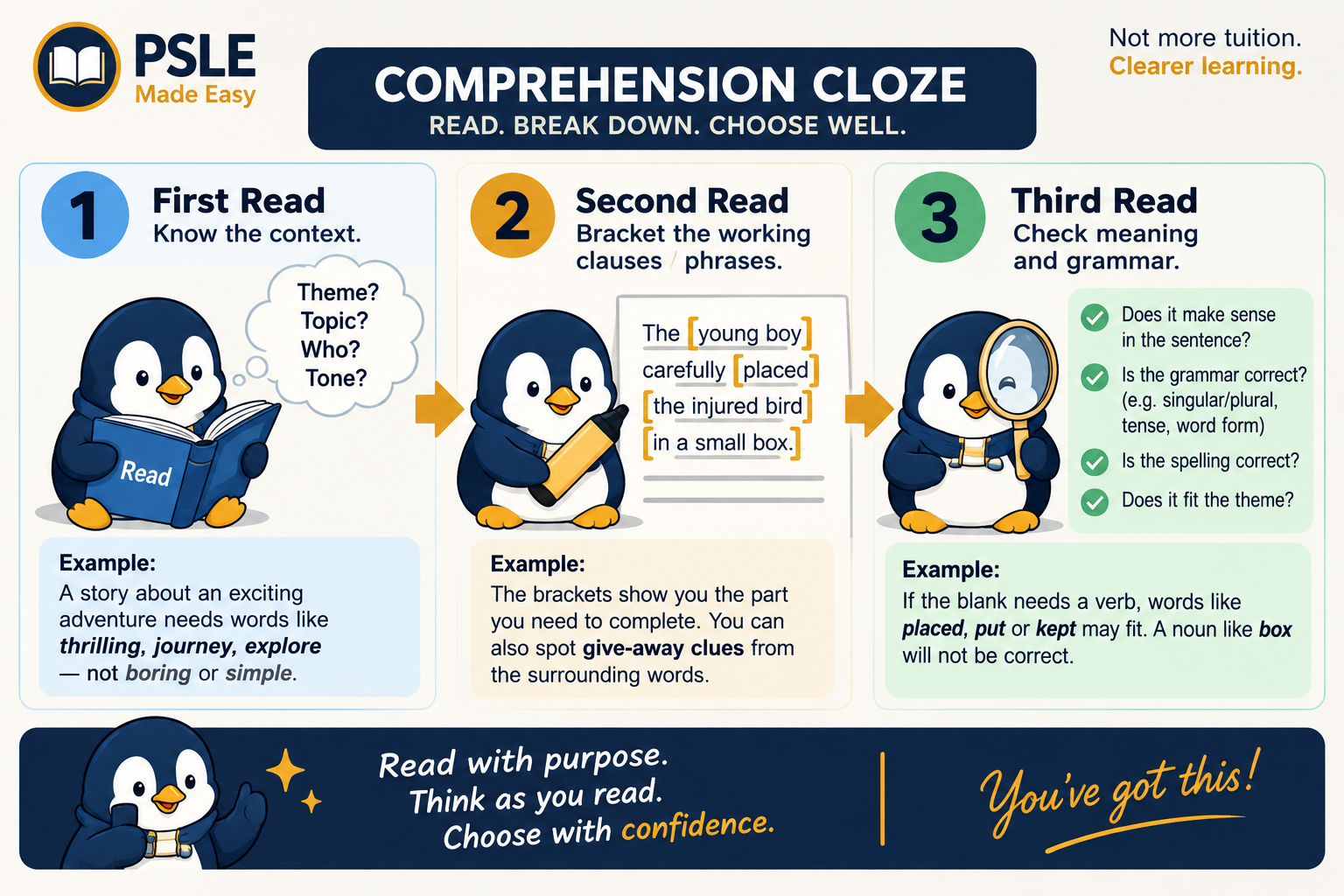
This is the three-read routine I use with pupils. Each read has a different job: understand the context, find the working clause or phrase, then check the completed passage.
1. First Read — Know the Context
Read the passage once without trying to solve every blank. Work out what the passage is about and where it is heading.
the topic • the purpose • the tone • the paragraph direction
Different contexts demand different words. A pupil may think of a word with a similar general meaning, but the passage may require a more natural or more precise choice.
“Used with care and purpose, social media can ___ new doors to knowledge for young minds.”
Open is the natural choice: open new doors. A word such as create may seem close in meaning, but it does not fit the expression naturally. The context and the phrase work together.
2. Second Read — Bracket the Working Clauses and Phrases
Now break long sentences into smaller working clauses or phrases. Bracket the part that actually controls the blank.
Pupils with a stronger reading level often get many of their first answers at this stage. Once the sentence is broken down, the clue becomes easier to see.

3. Third Read — Check Meaning, Grammar and Theme
By now, you should already have preliminary answers for many blanks. Read the passage again with those answers inserted.
Grammar matters because a word can make sense in meaning and still be wrong in form.
singular / plural • tense • word form • verb form • spelling • punctuation
4. See the Three Reads Working Together
“However, students must be ___ when using social media as a learning platform. Not everything online is trustworthy. Anyone can post content, ___ it is true or not. Some accounts may ___ convincing but they may be misleading.”
Some accounts [ may ___ convincing ].
appear fits the meaning and stays in the base form after may.
5. What Type of Answer Is the Blank Asking For?
Not every blank is solved in the same way. Before guessing a word, ask what is controlling the answer. These are useful classroom categories rather than official examination labels.
Example:
“Information from trusted experts is usually more ___.”
The context points to reliable.
Example:
“These videos are ___ to understand than long textbooks.”
Than signals a comparative: easier.
Examples:
“___ a long day at school” → after
“___ it is true or not” → whether
Examples:
“at their own ___” → pace
“___ new doors” → open
Example:
“Two routes were available. One was shorter; the ___ was safer.”
The link between the two routes points to other.
This is why the second and third reads matter. Do not ask only, “What word could fit?” Ask, “What is this blank demanding, and what evidence narrows the answer?”
6. Why 7–8 Marks Can Be Within Reach
In my classroom experience, pupils with a reasonable reading level who learn to break down paragraphs and long sentences can often reach at least 7–8 marks out of 15. They do not need to know every difficult word. They need to stop giving away blanks that the sentence has already helped them solve.
7. The Scary Part — Rushing
What worries me most is not always a difficult passage. It is a pupil who actually has enough reading ability, but rushes through the answers and never gives that ability a chance to work.
8. Final Check Before You Move On
□ Did I bracket the working clause or phrase?
□ Can I see the clue for my answer?
□ Does the completed sentence make sense?
□ Is the grammar correct?
□ Did I check singular / plural, tense and word form?
□ Is the spelling correct?
□ Did I reread instead of rushing on?
9. Sources & Further Reading
Official format: SEAB confirms that the 2026 PSLE English Paper 2 includes a 15-item, 15-mark open-ended Comprehension Cloze section.
SEAB — 2026 PSLE English Language examination format
PSLE Made Easy — previous Comprehension Cloze page